
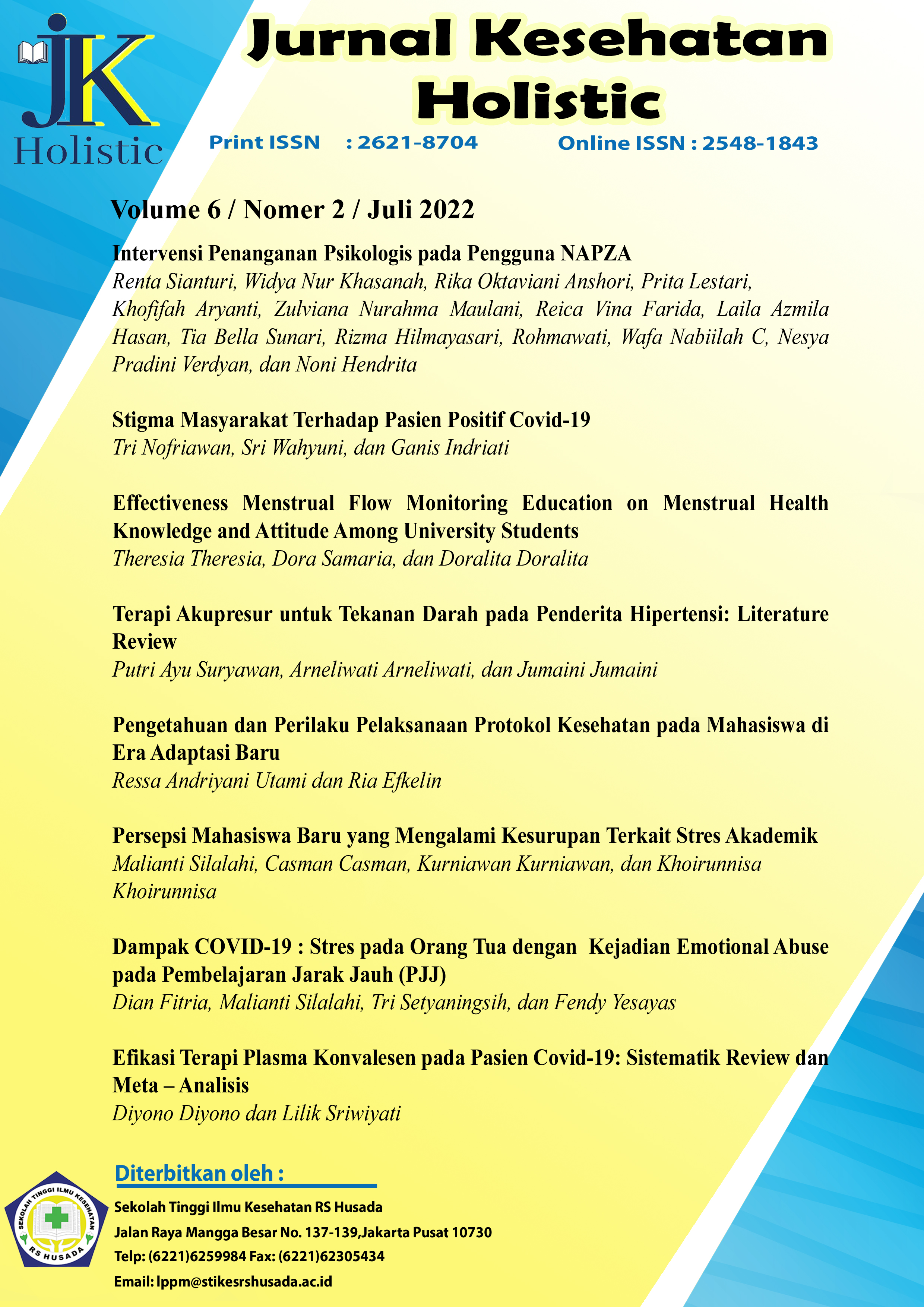
Effectiveness Menstrual Flow Monitoring Education on Menstrual Health Knowledge and Attitude Among University Students
DOI:
https://doi.org/10.33377/jkh.v6i2.129Keywords:
Attitude, Knowledge, Late Adolescent, Menstrual Calendar, Menstrual Flow Monitoring, Menstrual Flow ChartAbstract
Introduction: Female population 10 to 24 years old occupied almost in 30% of total female population. Female students as one of this subpopulations fall in the late adolescent age and experience a menstrual cycle. It is possible that some of them experience irregular menstrual cycles and have menstrual health issues such as premenstrual syndrome. Lack of early health education in this regard can result difficulty in early detection of menstrual abnormalities and it may develop into a serious reproductive organ disorder that continues into adulthood. Objective: This study aimed to identify the effect of menstrual flow monitoring (MFM) on the knowledge and attitudes related to menstrual health through lectures, demonstrations, and exercise methods, using the menstrual flow chart (MFC) and the menstrual calendar (MC) during sessions. Metode: This study design was quasi-experimental with only one group pretest and posttest. The subjects were 117 female students from the Teacher College of Economics Study Program who were selected by purposive sampling method. The data collected were processed using paired t-test. Data analysis revealed significant increase in the mean score of pretest to second posttest on the variables knowledge (p = 0.006) and attitude (p = 0.000). Result: This study results emphasize the need for further randomized control trial studies aimed at a larger population to disclose more relevant findings.
References
Anitha, S., Karupiah. (2015). Effectiveness of planned teaching programme of menstrual hygiene on knowledge, attitude, and practice among the adolescent girl in Government school in Chennai, Tamilnadu. Retrieved from http://hdl.handle.net/10603/204503
Azwar, Saifuddin. (2013). Sikap Manusia. Yogyakarta: Pustaka Pelajar.
Badan Pusat Stastisik (BPS). (2021). 2021: Perempuan dan Laki-laki di Indonesia. Retrieved from https://www.bps.go.id/publication/2021/12/16/9261644618cd6b95e5ab5840/perempuan-dan-laki-laki-di-indonesia-2021.html
Bobak, Lowdermilk, dan Jensen. (2005). Buku Ajar Keperawatan Maternitas. Edisi 4. Jakarta: EGC.
Dahlan, M.S. (2010). Besar Sampel dan Cara Pengambilan Sampel dalam Penelitian Kedokteran dan Kesehatan. Jakarta: Salemba Medika.
Dahlan. (2011). Statistik untuk Kedokteran dan Kesehatan. Jakarta: Salemba Medika.
Haque, S. E., Rahman, M., Itsuko, K., Mutahara, M., & Sakisaka, K. (2014). The effect of a school-based educational intervention on menstrual health: an intervention study among adolescent girls in Bangladesh. BMJ open, 4(7), e004607. https://doi.org/10.1136/bmjopen-2013-004607
Maulana, H.D.J. (2014). Promosi Kesehatan. Jakarta: EGC.
Milanti, Sulistiawati, Fransiska, Nugroho. (2017). Gambaran faktor-faktor yang mempengaruhi siklus mesntruasi pada mahasiswa fakultas kedokteran Universitas Mulwarman. E-jurnal Kebidanan Mutiara Mahakam volume V nomor 1, Maret 2017.http://ojs.akbidmm.ac.id/index.php?journal=akbidmm&page=article&op=view&path%5B%5D=44
Moon, G., Kim, I., Kim, H., Choe, S., Jeon, S., Cho, J., Hong, S., & Lee, J. (2020). How can we improve knowledge and perceptions of menstruation? A mixed-methods research study. BMC women's health, 20(1), 214. Retrieved from https://doi-org.autorpa.ntunhs.edu.tw/10.1186/s12905-020-01007-4
Notoatmodjo, Soekidjo, Promosi Kesehatan: Teori & Aplikasi. Jakarta: Rineka Cipta, 2010.
Pusat Data dan Informasi Kementrian Kesehatan RI, Situasi Kesehatan Reproduksi Remaja. Jakarta: Kemenkes RI, 2015.
Satya Sai Shita, N., & Purnawati, S. (2016). PREVALENSI GANGGUAN MENSTRUASI DAN FAKTOR-FAKTOR YANG MEMPENGARUHI PADA SISWI PESERTA UJIAN NASIONAL DI SMA NEGERI 1 MELAYA KABUPATEN JEMBRANA. E-Jurnal Medika Udayana. https://ojs.unud.ac.id/index.php/eum/article/view/29496
Sharma, Neelima et al. (2013). ‘A cross sectional study of knowledge, attitude and practices of menstrual hygiene among medical students in north India’, The Journal of Phytopharmacology, 2(5). https://www.phytopharmajournal.com/V2issue505.pdf
Shiferaw, M. T., Wubshet, M., & Tegabu, D. (2014). Menstrual problems and associated factors among students of Bahir Dar University, Amhara National Regional State, Ethiopia: A cross-sectional survey. The Pan African medical journal, 17, 246. https://doi.org/10.11604/pamj.2014.17.246.2230
State Adolescent Health Resource Center University of Minnesota. Understanding Adolescence: Seeing through a Developmental Developmental Tasks and Attributes of Late Adolescence/ Young Adulthood. https://sahrc.umn.edu/sites/sahrc.umn.edu/files/2021-01/late_adol_stage-eng.pdf
Shoor P. (2017). A study of knowledge, attitude, and practices of menstrual health among adolescent schoolgirls in urban field practice area of medical college, Tumkur. Indian J Health Sci Biomed Res. https://www.ijournalhs.org/text.asp?2017/10/3/249/213999
Varnell, R. R., Arnold, T. J., Quandt, S. A., Talton, J. W., Chen, H., Miles, C. M., Daniel, S. S., Sandberg, J. C., Anderson, K. A., & Arcury, T. A. (2021). Menstrual Cycle Patterns and Irregularities in Hired Latinx Child Farmworkers. Journal of occupational and environmental medicine, 63(1), 38–43. https://doi.org/10.1097/JOM.0000000000002065
Published
How to Cite
Issue
Section
License
Copyright (c) 2022 Jurnal Kesehatan Holistic

This work is licensed under a Creative Commons Attribution-ShareAlike 4.0 International License.
Before submission,
- You have to make sure that your paper is prepared using the JKH Paper Template, has been carefully proofread and polished, and conformed to the author guidelines
- If the manuscript submitted is not appropriate with the guidelines or written in a different format, it will BE REJECTED by the editors before further reviewed. The editors will only accept the manuscripts which meet the assigned format.
Published by Sekolah Tinggi Ilmu Kesehatan RS Husada
Jl. Mangga Besar Raya No.137-139, Jakarta Pusat, 10730 - Indonesia
Email: lppm@stikesrshusada.ac.id
Web: https://ejournal.stikesrshusada.ac.id/index.php/jkh/

JKH is licensed under a Creative Commons Attribution-ShareAlike 4.0 International License.
Copyright ©Sekolah Tinggi Ilmu Kesehatan RS Husada
All right reserved